
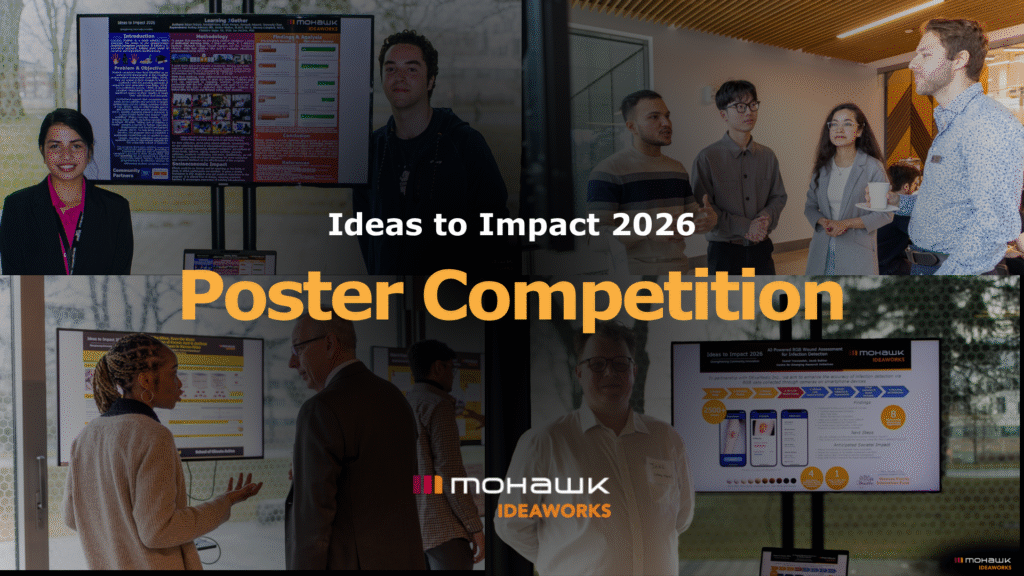
An array of exceptional research projects were recognized at the 2026 Ideas to Impact conference poster competition, each addressing pressing community and industry challenges through applied research and innovation.
JUDGES CHOICE #1 | LEARNING 2GETHER
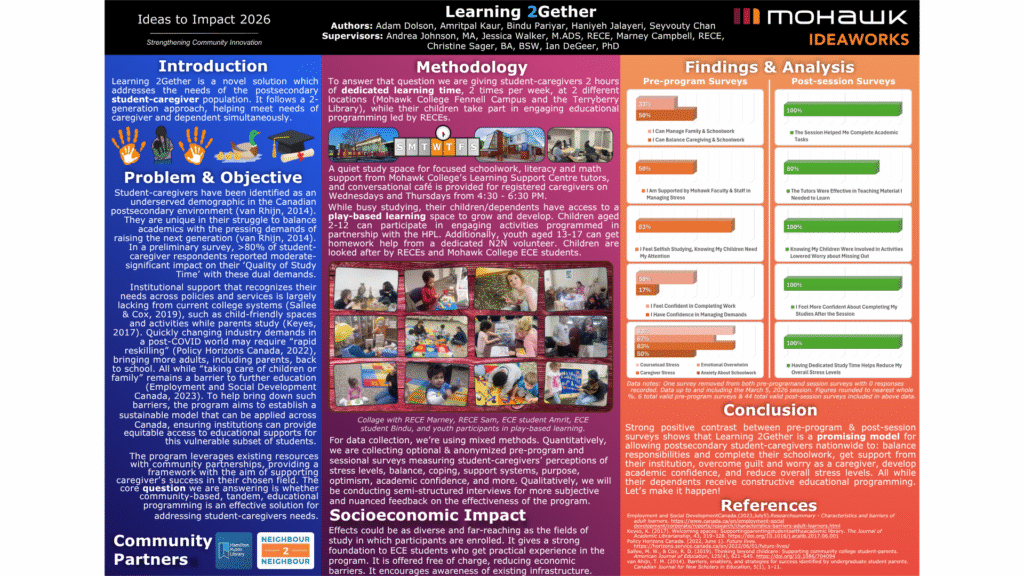
Team: Adam Dolson, Bindu Pariyar, Seyvouty Chan, Haniyeh Jalayeri, Amritpal Kaur
Learning 2Gether tackles a critical gap in postsecondary support: the needs of student-caregivers. Over 80% of student-caregivers report moderate to significant impact on their quality of study time when balancing academics with parenting responsibilities.
The program offers a two-generation solution. Student-caregivers receive dedicated learning time twice weekly—including a quiet study space, tutoring from Mohawk College’s Learning Support Centre, and peer support through a conversational café. Meanwhile, their children participate in play-based learning led by Registered Early Childhood Educators (RECEs) and Mohawk ECE students, with homework help available for youth aged 13–17.
Offered free of charge at two locations (Mohawk College Fennell Campus and Terryberry Library), Learning 2Gether leverages existing institutional resources with community partnerships. Early survey data shows strong positive impact: post-session feedback indicates 100% of participants felt the program helped them complete academic tasks, develop academic confidence, and reduce overall stress. The research team sees potential to scale this model across Canadian postsecondary institutions, helping dismantle barriers to educational access for vulnerable student populations.
JUDGES CHOICE #2 | FIGHT THE MITES, SAVE THE BEES
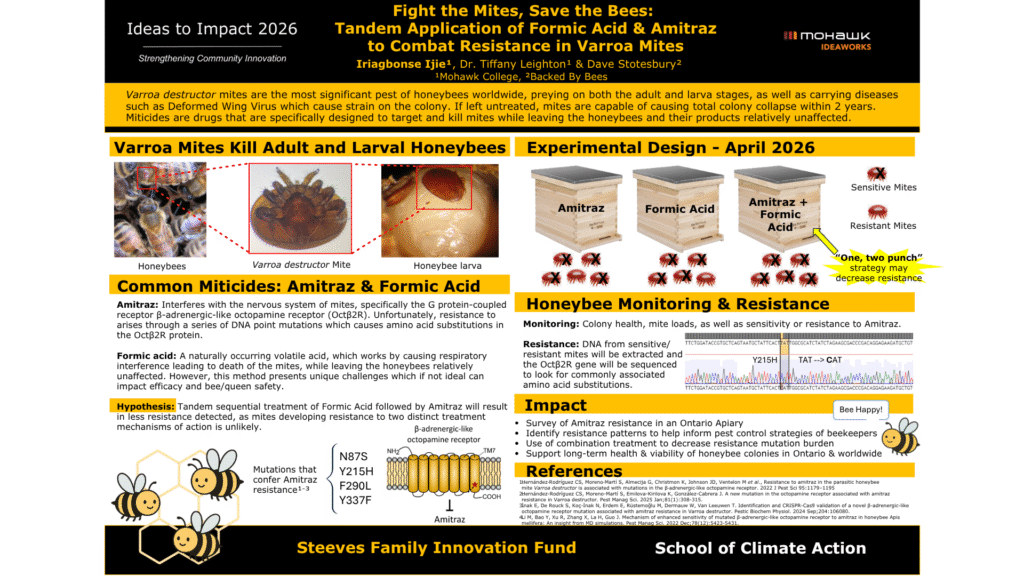
Team: Iriagbonse Ijie
Varroa destructor mites represent the most significant global pest threat to honeybee colonies. Left untreated, they can cause total colony collapse within two years through direct predation and disease transmission, including Deformed Wing Virus.
This project investigates a novel approach: tandem sequential treatment using formic acid followed by amitraz. While both miticides are effective, resistance is emerging through DNA mutations in the mite’s octopamine receptor gene. The hypothesis is that treating mites with two distinct mechanisms of action will make resistance mutations less likely to develop.
The research includes monitoring colony health and mite loads, extracting DNA from sensitive and resistant mite populations, and sequencing the Octβ2R gene to identify amino acid substitutions linked to resistance. Results will help inform pest control strategies for beekeepers and support the long-term viability of honeybee colonies in Ontario and beyond—critical for food security and ecosystem health.
AUDIENCE CHOICE | AUTOMATED TRAIN IDENTIFICATION FROM RAILWAY VIDEOS USING COMPUTER VISION

Team: Yashkaran Yashkaran, Pushpinder Badoni, Gul Afroz Akbari, Long Gia Truong
Railway documentation and research often require manual extraction of train identification markings from video—a time-consuming and error-prone process. Motion blur, variable lighting, and brief text visibility create significant accuracy challenges.
This project develops an automated pipeline combining detection, tracking, and optical character recognition (OCR) to extract train car markings from video footage. By automatically selecting the clearest frame from a sequence, the team overcomes motion blur and lighting variation to improve OCR accuracy. The integrated system is evaluated on precision, recall, and character-level accuracy.
Automating this workflow supports railway research and documentation, enables large-scale transportation data analysis, and reduces manual workload for organizations managing rail assets.
HONORABLE MENTION | AI-POWERED RGB WOUND ASSESSMENT FOR INFECTION DETECTION
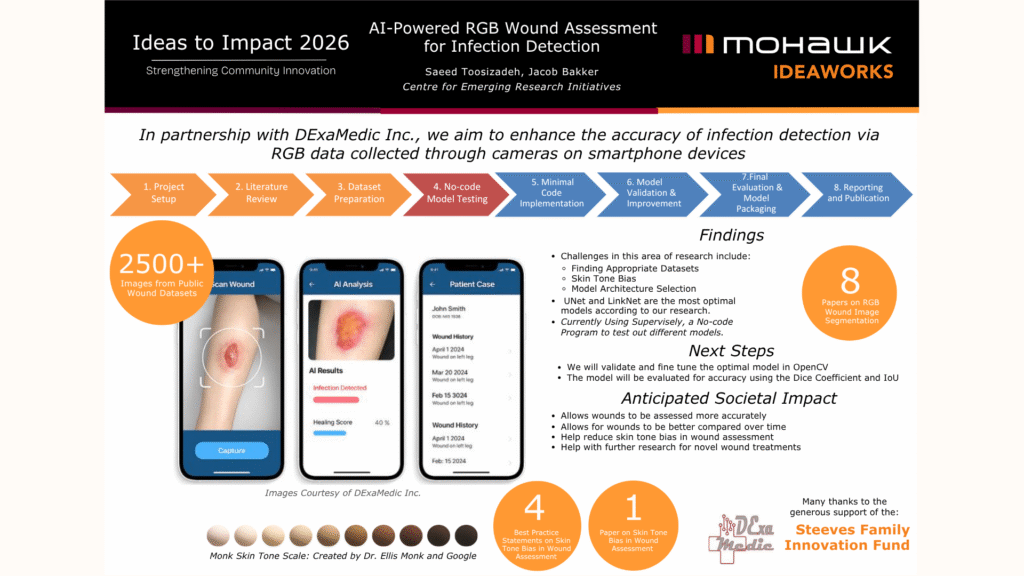
Team: Jacob Bakker, Centre for Emerging Research Initiatives
Jacob Bakker’s research, conducted in partnership with DExaMedic Inc. and supervised by Saeed Toosizadeh, applies AI to enhance the accuracy of infection detection using RGB data from smartphone cameras. Working with datasets of 2,500+ wound images and leveraging the Monk Skin Tone Scale, the project addresses critical challenges including skin tone bias in clinical wound assessment. Validation will use standard metrics including Dice Coefficient and Intersection over Union (IoU). This work aims to reduce healthcare disparities and enable more consistent wound monitoring over time.
ALL POSTERS AVAILABLE FOR DOWNLOAD
Download the full research posters below to explore the methodology, findings, and impact of each project.
ABOUT THE IDEAS TO IMPACT 2026 POSTER COMPETITION
The poster competition showcased applied research and student innovation from across Mohawk College’s research centres and programs. Projects were evaluated by a panel of judges and by conference attendees voting for their favourite work. Winners were announced at the event’s closing remarks on Tuesday, March 31, 2026.